
Attach collaborative resources to channels
A channel's members usually work on something — a canvas, a shared todo list, a brief. Channel resources make that first-class: the host declares its own CRDT document collections (the schemas stay yours), and @super-line/plugin-chat turns them channel-native — a link registry per channel, server-authoritative creation, membership-gated access (every member reads and writes, nobody else), an acked write path built for agents, and coarse who's-open presence.
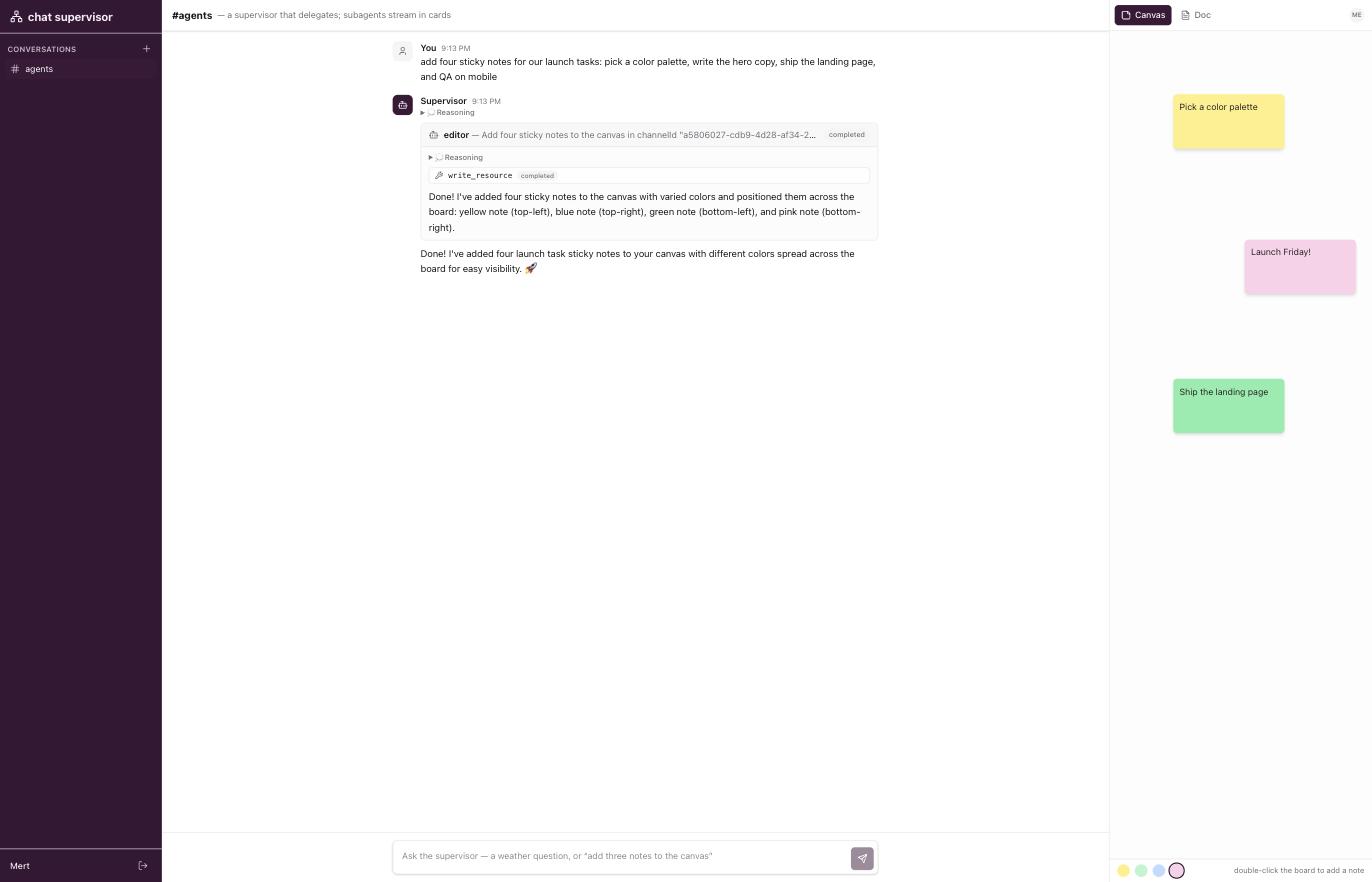
Two runnable versions: examples/chat-resources is the headless mechanics (CLI, no UI); examples/chat-supervisor is the full web app — a human and an AI agent editing one canvas live. To build it yourself step by step, follow Tutorial 6.
The model
A resource is one CRDT document plus a registry row that links it to a channel. The document is a normal CRDT document collection you declare on the contract — the plugin never owns your schema. The registry (resources) is what makes it channel-native: it records which doc is attached to which channel, and every access check reads from it.
channel  ──< resources (registry) >──  CRDT document
 #design      { channelId, kind,          { title, items: {...} }
              collection, docId, title }   (your schema, opened by id)

           membership(channel) ─┐
                                ├─ gate every read + write + presence row
           resolveResourceAccess(collection, docId) ─┘
Why a link registry and not just an id convention? You might imagine encoding the channel into the doc id (design:canvas-1) and skipping the registry. It doesn't hold up: a doc's id is often host content that predates the channel (a design scene's UUID, a document id) and can be attached to more than one channel (linked kinds). The id can't carry the membership relationship, so access has to be a lookup — "is this doc attached to a channel you're in?" — which is exactly what the registry answers. It's also what lets a resource move or fan out across channels without rewriting doc ids.
Access is membership-gated through that registry: registering a kind auto-contributes read/write policies that resolve channel(s) this doc is attached to → are you a member?. Every member reads and writes; non-members can't see the doc, its registry row, or its presence rows.
1 · Declare the collections (host-owned schemas)
const app = defineContract({
  collections: {
    todos:    { schema: todoSchema,   crdt: { mode: 'document' } },
    canvases: { schema: canvasSchema, crdt: { mode: 'document' } },
  },
  roles: { user: {} },
  plugins: [authContract(), chatContract()],
})
Schemas must be presence-tolerant — a concurrent merge can transiently drop a field, so a schema that requires it would reject a write that is in fact valid. Fields several members edit concurrently need .catch()/.optional(). Strict (catch-less) fields are safe only when set once — and they're the ones a bad write can actually be rejected on.
2 · Register the kinds (one act, three effects)
const chatKit = chat({
  contract: app,
  resources: {
    kinds: {
      todo:   { collection: 'todos', init: () => ({ items: {} }) },              // owned (default)
      canvas: { collection: 'canvases', lifecycle: 'linked',
                init: async (c) => seedCanvas(c.params) },                        // host validates params
    },
  },
})
Registering a kind is the wiring: it enables createResource for it, contributes the membership-gated read/write policies for that collection (do not also write your own policies entry for it — the server throws "policy … collides" at boot; registration owns the policy), and enrolls the kind in the channel-delete cascade.
Two lifecycles:
owned (default) | linked | |
|---|---|---|
| doc id | server-minted | host-suppliable (createResource({ id })) |
| channels | exactly one | attachable to many |
| on detach / channel delete | doc deleted | registry row removed, doc untouched |
linked is for docs that ARE your product content (a design scene, a document) — chat never deletes them. createResource on a linked kind is create-or-attach: an existing id attaches (init skipped), and two racing creators both succeed onto one registry row.
Server-side: chatKit.resources
The requests above have a server-side twin on chatKit — running through the same domain cores, but initiator.kind === 'server', so there's no membership check and (being server-initiated) no card lands in the message feed:
chatKit.resources.create({ channelId, kind, title?, id?, params? }) // create-or-attach → ChatResource
chatKit.resources.detach(channelId, kind, docId)                    // → ChatResource; owned kinds delete the doc too
chatKit.resources.of(channelId)                                     // → ChatResource[] — the channel's registry rows
chatKit.resources.find({ filter?, limit?, offset? })                // → ChatResource[] — the bulk read, across channels
The access resolvers
Registration is the policy: the guards that gate a resource doc are auto-contributed from the kinds you register (see Access). The same three resolvers that back those guards are public, so a host writing its own row policies over its own collections answers "who can see this doc?" with the plugin's logic instead of re-deriving it:
chatKit.resources.channelsOfDoc(collection, docId)   // → string[] — channels granting access; [] = unattached
chatKit.resources.canAccessDoc(collection, docId, userId) // → boolean — member of ANY granting channel?
chatKit.resources.docIdsOf(collection, userId)       // → string[] — every doc in `collection` the user can reach
chatKit.members.get(channelId, userId)               // → ChatMembership | undefined (the role comes with it)
All three are scope-first, principal-last, and throw NOT_FOUND for a collection no registered kind points at — a typo must not read as a denial. Use docIdsOf as the one-hop input to a policy over a collection of your own that references a resource doc:
policies: {
  sceneNotes: {
    read: async (_p, ctx) => {
      const uid = (ctx as AuthContext).userId
      return uid ? isIn('sceneId', await chatKit.resources.docIdsOf('scenes', uid)) : isIn('id', [])
    },
  },
}
The usual row-policy staleness applies: the filter is captured when the client subscribes, so a doc attached to a new channel afterwards stays invisible to that subscription until it resubscribes.
examples/chat-supervisor uses of + create to auto-seed every channel with a canvas and a doc the moment it appears, so no member ever has to attach one by hand:
const existing = await chatKit.resources.of(channelId)
for (const kind of ['canvas', 'doc'] as const) {
  if (!existing.some((r) => r.kind === kind))
    await chatKit.resources.create({ channelId, kind, title: kind === 'canvas' ? 'Canvas' : 'Doc' })
}
See the chat plugin how-to for the rest of chatKit (channels, members, messages) and sweepPresence, covered under Presence below.
3 · Use it from the client
const chat = chatClient(client, { userId })
const store = chat.resources(channelId)                    // live registry rows
const row   = await chat.createResource(channelId, { kind: 'todo', title: 'Launch list' })

// collaborate through the NATIVE doc surface — chat wraps nothing here
const doc = client.collection(row.collection).open(row.docId)   // or react's useDoc
doc.update({ items: { 'i-1': { text: 'ship it', done: false } } })

await chat.detachResource(channelId, 'todo', row.docId)    // owned ⇒ doc deleted too
React: useChannelResources(channelId) (live registry) and useResourcePresence(row) (below). Every member — human, bot, or a pod-agent connected as a real client — passes the same membership gate; unattached docs are invisible through chat entirely.
Creating/attaching/detaching drops a resource card into the message stream: a content-less message carrying metadata.resource ({ action, kind, docId, title }). Because it's a normal message row, it arrives in the same useMessages feed — branch on the metadata to render it as a card instead of a bubble:
function MessageRow({ m }: { m: FeedMessage }) {
  const card = (m.metadata as { resource?: ResourceCard } | undefined)?.resource
  if (card) {
    return (
      <div className="resource-card">
        {card.action === 'created' ? 'created' : card.action === 'attached' ? 'attached' : 'removed'}{' '}
        <strong>{card.kind}</strong> “{card.title}”
      </div>
    )
  }
  return <Bubble m={m} />
}
Resource cards are ordinary message envelopes. A host-owned automation loop can skip them by checking metadata.resource, so the agent won't try to "answer" its own resource creation.
4 · Agent writes: the acked path
DocHandle writes are optimistic and void — a rejected write surfaces later as a client resync, which an LLM tool can't observe. Agents (and anything needing a synchronous answer) use writeResource instead: path ops applied server-side, validated against the kind's schema on a projection first, with the post-write snapshot returned — or a VALIDATION error whose zod message the model reads and corrects against.
Paths address object keys only (string segments) — an array is replaced wholesale by setting it at its key; indexing into one is rejected (VALIDATION) because CRDT arrays are opaque leaves.
await chat.writeResource(channelId, 'todo', docId, [
  { path: ['items', 'i-2'], set: { text: 'review palette', done: false } },
  { path: ['items', 'i-1', 'done'], set: true },
  { path: ['items', 'i-0'], delete: true },
])
The /ai toolset gains list_resources · read_resource (16 KB-capped snapshot) · create_resource · detach_resource · write_resource, all riding the bot's own connection (the server re-authorizes everything). Pass resourceShapes: { todo: '{ items: … }' } so the model knows each kind's shape without reading first.
5 · Presence: who's in the doc
Coarse, row-based (it works on every deployment tier — rooms don't cross nodes on self-tier clusters), per user not per tab:
const present = useResourcePresence(row) // announces open/heartbeat/close for you; returns live rowsLiveness is heartbeatAt recency (20 s beats, 45 s window — PRESENCE_LIVE_MS). Reap old rows from host code with chatKit.resources.sweepPresence({ olderThanMs }) (the sweepStale pattern — the plugin runs no timers). Live cursors/selections are deliberately out of scope for now.
Caveats worth knowing
- Revocation is lazy for open docs: doc read policies run at open (and every reconnect re-open), so a member detached from a
linkeddoc keeps receiving deltas until their doc closes or the connection drops — the same captured-at-subscribe staleness as row subscriptions. Hard revocation:srv.toUser(userId).disconnect(). writeResourcevalidation is best-effort honesty, not an engine invariant: server co-writes are authoritative by design; a concurrent delta between validate and apply is an accepted tiny race..catch()fields never reject — they self-heal at the next client-delta validation.- The cascade is sequential, not atomic (registry rows first, then owned docs): a crash mid-cascade can orphan an invisible doc (no registry row ⇒ no access), never a dangling row.
Where to go next
- Tutorial 6 — build a chat channel where a human and an agent co-edit a canvas: the guided, guaranteed-outcome build of the app in the screenshot above.
- CRDT document collections: the underlying document model — merge semantics, validate-before-commit, and why the schemas must be presence-tolerant.
- Chat bots: provisioning the agent as a real channel member so its
write_resourcecalls pass the same membership gate as a human. examples/chat-supervisor: the full source behind the screenshot.